
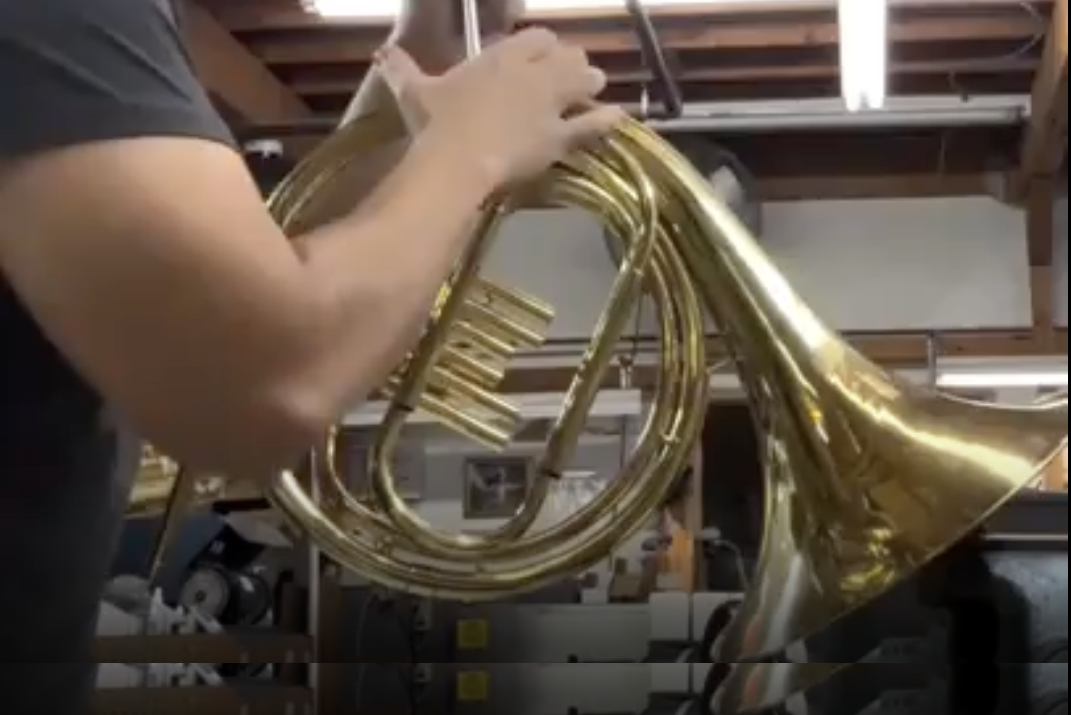
A dented, sticky, or silent French horn is stressful enough without making the damage worse before it reaches a repair technician. French horns are especially delicate instruments — their long, coiled tubing, thin brass walls, and rotary valve mechanisms don't forgive quick fixes. Here are three well-intentioned mistakes we see constantly, and why each one makes our job (and your repair bill) harder.
1. Don't Try to "Pop Out" a Dent Yourself
A dent near the bell or in the tubing looks like something you could just push out with a thumb, a pencil, or a coat hanger. Resist the urge.
French horn tubing is thin and tightly wound; pressing from the outside often creases the metal instead of smoothing it, or cracks solder joints you can't see.
Homemade tools (pens, screwdrivers, dowels) can scratch the inside of the bore or push the dent the wrong direction, turning a simple planishing job into a full tube replacement.
Technicians use dent balls, mandrels, and leadpipe-specific tools sized to the exact taper of horn tubing — there's no safe household substitute.
What to do instead: Note where the dent is and whether it affects airflow (does a slide move, is a valve sluggish?), then bring it in as-is.
2. Don't Oil, WD-40, or "Free Up" Stuck Valves
When a valve sticks, the instinct is to squirt in whatever lubricant is on hand and work it back and forth. This is one of the fastest ways to turn a small valve service into a much larger rebuild.
WD-40 and household oils are solvents/degreasers, not instrument lubricants — they strip the proper rotor oil, gum up over time, and can damage the felts, corks, and string linkage in the rotary mechanism.
Forcing a stuck valve can bend the rotor shaft or snap the linkage string, which then requires disassembly of the whole valve cluster to fix — a much bigger job than a stuck valve alone.
If the stickiness is from a dent restricting rotor movement (not just dirty oil), forcing it can turn a repairable dent into a cracked casing.
What to do instead: Stop pressing the valve once it feels resistant. Bring it in with a note on which valve(s) are affected — that alone saves diagnostic time.
3. Don't Keep Playing Through a Problem
Especially with student players, there's pressure to keep rehearsing on a horn that's "still mostly working" — a leaking water key, a loose slide, a rattling valve cap.
Playing with a stuck or misaligned valve forces extra pressure through the mechanism and can warp the rotor or valve casing permanently.
A slow leak (water key, slide, or solder joint) that seems minor gets worse with continued moisture and playing pressure, and can turn a quick reseat into a full resolder.
Continuing to play with a bell dent near a brace can stress the brace joint until it separates, adding a repair that wasn't part of the original damage.
What to do instead: If something feels off — sluggish valves, air leaking somewhere unexpected, a new rattle — pause and get it evaluated. Minor issues caught early are almost always cheaper and faster to fix.
Bottom line: French horns are built to be repaired by someone with the right tools, not fixed in the moment. The best thing a parent or teacher can do when something goes wrong is stop, document what's happening, and get it to a tech quickly — before a small issue becomes a structural one.